Thursday, 1 June 2017

Steel House: Strong, Reliable Wireless Network Breaks Through Steel and Concrete Structure

No matter how smart a home is, regardless of the intelligence of the products and systems installed inside it, if the wireless network in the house is shoddy, the smart home experience could be sub-par at best. When the owners of this 4,000-square foot steel-and-concrete home decided to integrate a variety of smart home technologies during home construction, they contacted a professional home systems integrator right away. It was a smart decision. The team at Digital Home Technologies, of Palatine, Ill., would be able to design and install a Wi-Fi networking system that could work around all the steel and concrete. There would be no dead spots, no signal drops, and no question of whether commands issued from a mobile device to lights, thermostats, A/V equipment and had been retrieved.
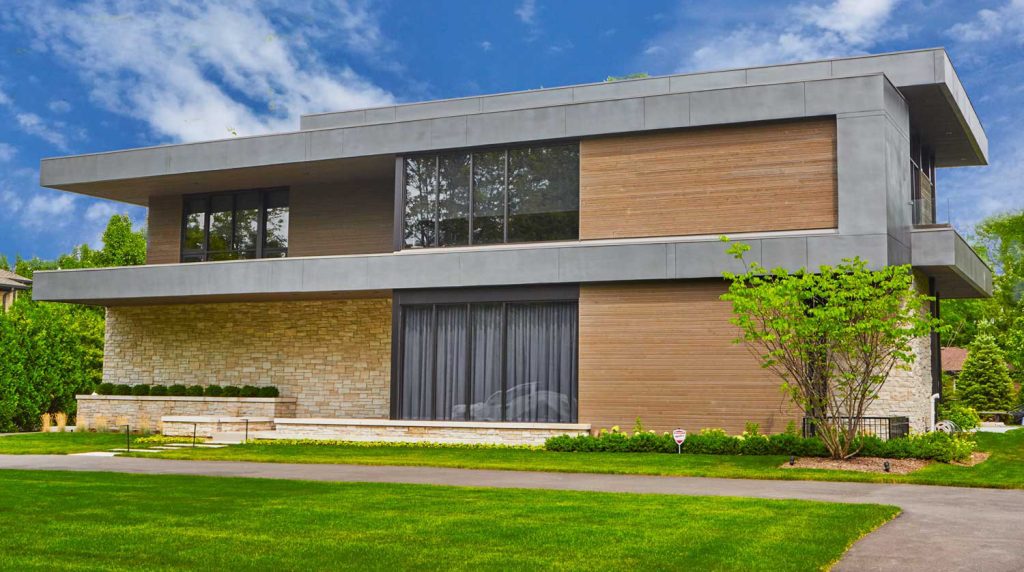
Wireless Network: Luxul Lays the Groundwork

An enterprise-grade Luxul Wi-Fi network handles the wireless communications; Digital Home Technologies also fished a high-speed low-voltage wire behind the walls to support a hardwired network. Together, the two networking solutions help this smart home function flawlessly for this busy family of four.
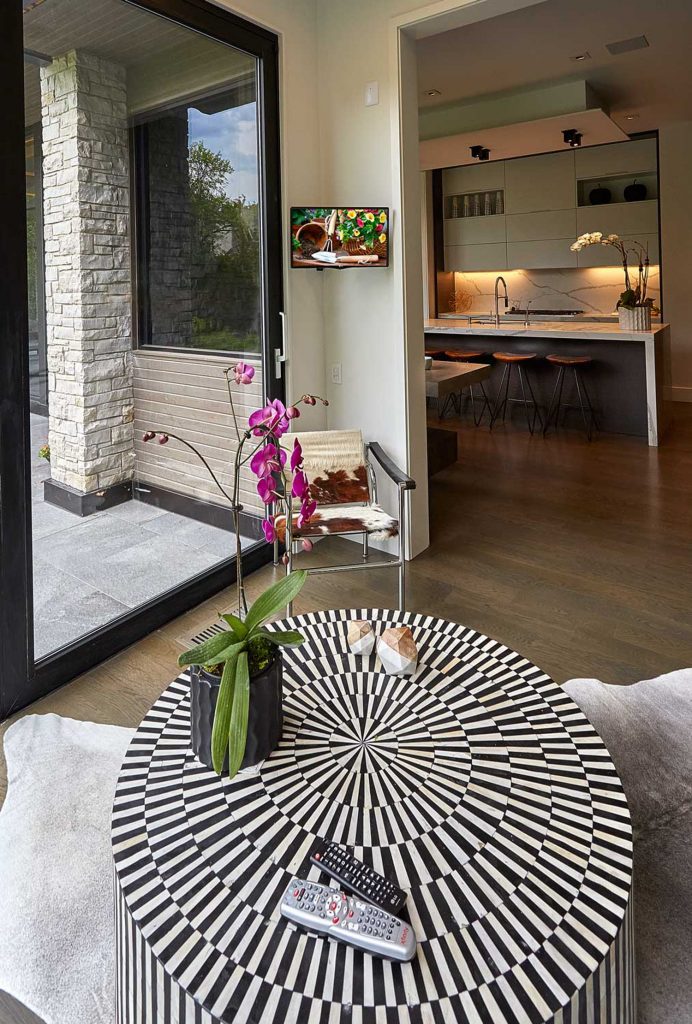
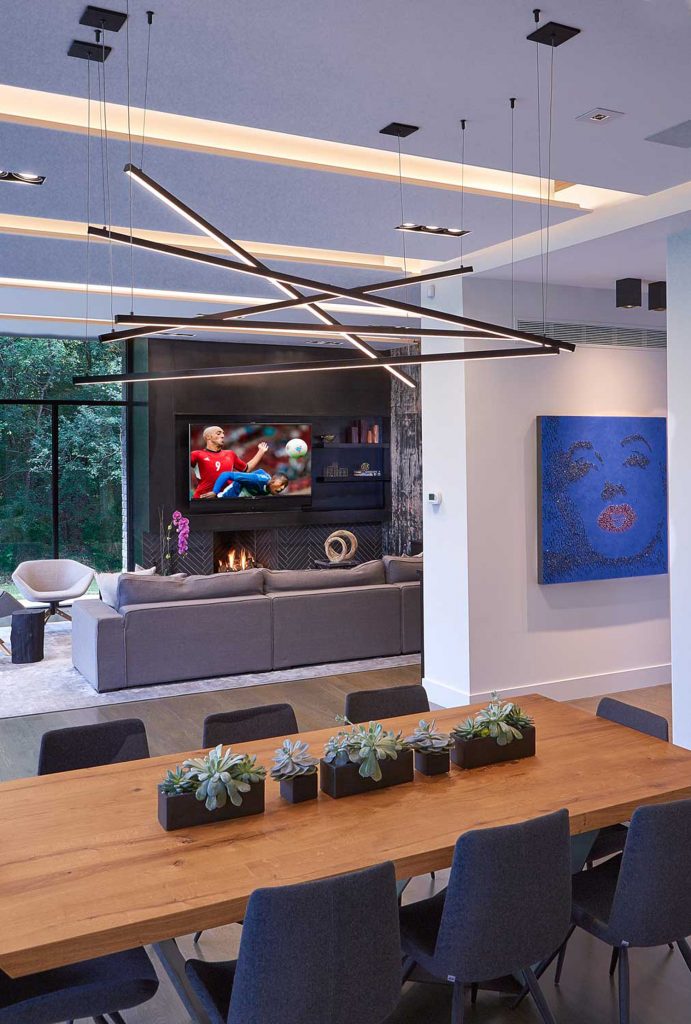
With the networking groundwork laid out and firmly in place, Digital Home Technologies loaded the house with smart home systems, including a Lutron lighting and shading system, Sonos music system tied to invisible DaVinci TDG ceiling speakers, and Ring video doorbells. The operation of these systems is unified under the aegis of a Universal Remote Control automation system and handheld remotes. A Lutron mobile app provides and extra layer of control from smartphones and tablets, and is used mainly for engaging special lighting scenes that were programmed into the Lutron system by Digital Home Technologies.
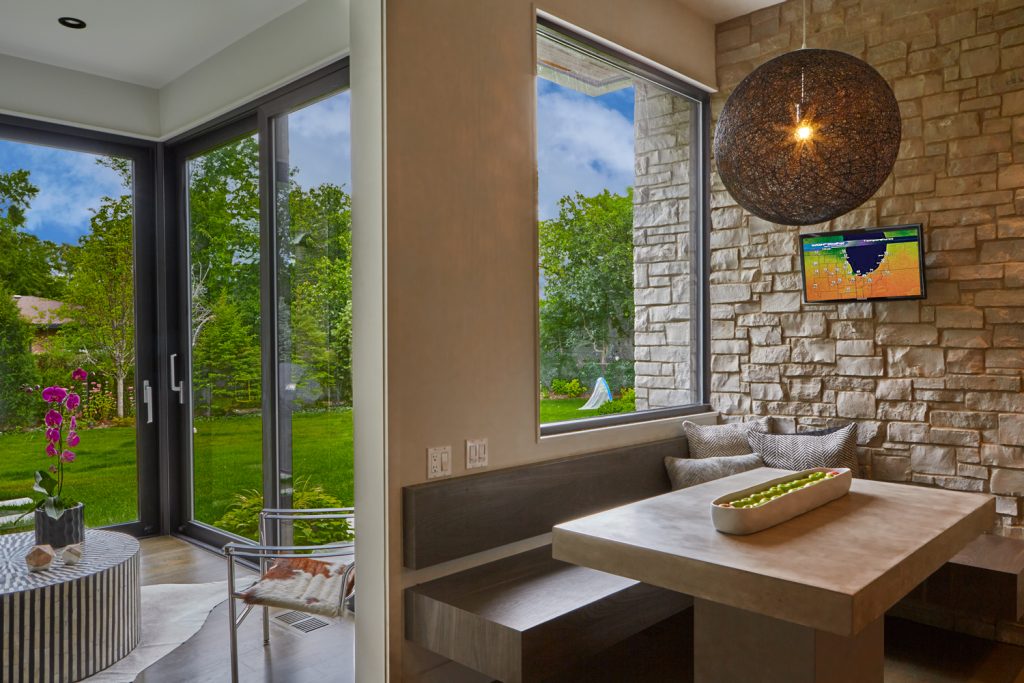
Synchronized with the Family Schedule

Most of the scenes were configured to coordinate with the family’s routines, such as morning, home, sunset, and good night. Other scenes accommodate certain activities, like movie, party, and chill. And what would a smart home be without some level of automation? Certain interior and exterior lights activate automatically based on the time of day.

Wi-Fi wasn’t the only piece of the technology installation affected by the steel and concrete. The unforgiving materials meant that the pros at Digital Home Technologies had to be diligent in their planning of the locations of TVs, speakers, and other equipment. Once the house was complete, it would be difficult if not impossible to sink a TV into a wall, so proper planning in the design phase was absolutely critical.

As unforgiving as steel and concrete can be,  Digital Home Technologies and the homeowners were able to work together to meld a variety of smart technologies into a home design, creating an environment that’s convenient to control and appealing to the eye.

The post Steel House: Strong, Reliable Wireless Network Breaks Through Steel and Concrete Structure appeared first on Electronic House.


source https://www.electronichouse.com/smart-home/steel-house-strong-reliable-wireless-network-breaks-steel-concrete-structure/

Tesla Solar Roof Tiles: Are They Worth the Cost?

By Jordan Wills, Cloud9 Smart


When Tesla unveiled its Solar Roof tiles last fall we all had the same question: How much? Consumer Reports calculated a max cost of $24.50 per square foot to compete in the market. Tesla just revealed the price, and running the same math came in at an impressive $21.85 per square foot. Do we finally have a viable solar energy solution for the home? Is it too good to be true?


The first thing to understand is what makes that $21.85 number viable. That cost is still significantly higher than a traditional roof ($43,000+ for a 2,000 square foot home.) The idea is that once your roof can generate most if not all of your home’s electricity, the energy saved over a 30-year period will completely offset the cost of the roof.


Tesla’s estimator factors in your square footage and number of floors, your neighborhood’s sun exposure and average electricity rates. Pricing includes your Powerwall, the cost of installation, and removal of your old roof. Tesla’s tiles are 3x stronger than standard roofing tiles, and they back them up with a warranty for the lifetime of your house… “Or infinity. Whichever comes first.” Let’s run an example:

A two-story, 3,000 square foot home in Ohio:

  • Cost of roof: -$61,400
  • Cost of Powerwall: -$7,000
  • Value of energy over 30 years: $51,600
  • Tax credit: $18,700
  • Net earned over 30 years: $1,900

While Tesla’s calculator factors in the federal 30% solar investment tax credit, it does not include any local incentives you may receive. Still, the upfront investment is big. Tesla will offer financing, but once you factor interest into the equation your savings will likely fly out the window…

So does it make sense to invest $21.85 per square foot into your roof?…

The two scenarios where this is worth considering are new construction projects or end-of-life of your existing roof. Tesla’s calculator does not factor in the money you would have to spend anyway on a traditional roof, so it’s not how expensive Tesla’s roof is but how much more expensive it is than a traditional roof. Once you find that number there are two ways to look at it:

  1. 30 years is too long to wait for a return on investment. The average family only stays in a home for 13 years, and there is no way to predict a solar roof’s impact on the resale value of my home. Why invest?
  2. Traditional roofs provide zero ROI, don’t offer lifetime warranties, and don’t look this good. If I need a roof anyway Tesla is the smarter choice, and will almost certainly add significant resale value to my home based on aesthetics, ongoing savings and eco-friendliness.

Every home is different. An AC-dependent mini mansion in Texas will have different solar potential than a modest mid-west ranch. Roof slope, neighboring buildings and trees… there are more factors to be considered beyond Tesla’s pricing calculator… but almost all would experience substantial ROI.


I recently interviewed one of our favorite architects and brought up Tesla. He replied, “It’s interesting you bring them up because they’ve been a strong part of our conversations with clients over the last 6 months.” He was talking about the Powerwall, which all of his clients seem to be interested in yet none are pulling the trigger on just yet. It seems there is a fine line between early adopter and beta tester, and a larger investment means a more skittish consumer.

This is Tesla’s big hurdle now. The numbers presented and Tesla’s track record tell us this is a smart investment. Still, people want field testing before they invest – real life case studies with real life numbers. The catch 22 is that people need to take the leap in order to generate those numbers.

So… who’s first?


The post Tesla Solar Roof Tiles: Are They Worth the Cost? appeared first on Electronic House.


source https://www.electronichouse.com/home-energy-management/tesla-solar-roof-tiles-are-they-worth-the-cost/

Outdoor Light Fixture Uses Artificial Intelligence to ID Vehicles in your Driveway

Artificial intelligence opens up a world of possibilities for smart homes. Kuna Systems has entered the market by developing an outdoor light that can evaluate and identify movement and objects outside of the home to make educated decisions. The inaugural feature is a first-of-its-kind vehicle recognition technology, which can identify the color, make and model of a vehicle in less than a second.


Kuna AI performs vehicle recognition through a sophisticated neural network, which is designed using deep learning and based on the human visual cortex. The technology has been trained on tens of thousands of images of vehicles and over time, it will learn to match cars to owners. For example, a black Ford Fusion means dad is home or a silver Toyota Prius means the babysitter has arrived.


This will serve as a building block for a wider range of capabilities that will enable Kuna Powered devices to function proactively in protecting homes and families. In the future, Kuna AI’s recognition will advance to not only identify the color, make and model of a vehicle, but a specific vehicle, such as a delivery truck or emergency vehicle.


Once the vehicle has been identified, the Kuna AI light can trigger other smart devices in the home. Currently, homeowners will receive a push notification through the Kuna app alerting them that a person or vehicle is outside the home. In the near future, the notification can include the car color and body type (Black SUV, Red Sedan). As the technology continues to learn through increased use, it will be able to proactively identify and react to assigned vehicles. For example, if a Blue Truck pulls up to the home, the smart security light will immediately trigger a siren or if a Silver Van pulls up, the light will turn on.


“Over time, we see this technology being able to ease the decision-making process for homeowners with suggested responses to activities outside the home. If dad’s car is identified as pulling up the driveway, the light can play an automatic greeting – ‘Welcome Home Dad!’’ says Haomiao Huang, CTO and co-founder of Kuna Systems. “Alternatively, if there is a string of crime in a neighborhood, a homeowner could identify various incidences of the suspected vehicle driving past the home. Then, they could assign a reaction to that vehicle to either trigger a siren or eventually, even send the footage to the police.”


To further enhance Kuna AI, Kuna will also be working within UC Berkeley’s RISE Lab. The collaboration with RISE Lab is a joint effort to push Kuna’s boundaries in artificial intelligence and vision recognition, while still achieving quick and accurate results.


The current iteration of Kuna AI is now available to ‘Absolute Control’ premium plan subscribers with a full feature rollout to all Absolute Control subscribers this summer, and wide availability to all Kuna premium plan subscribers this fall. Kuna AI is integrated with all Kuna Powered devices, including Maximus SSL and Toucan outdoor lights fixtures.

Huang says the AI technology adds nothing to the cost of the Kuna AI outdoor light fixtures.


The post Outdoor Light Fixture Uses Artificial Intelligence to ID Vehicles in your Driveway appeared first on Electronic House.


source https://www.electronichouse.com/home-security/outdoor-light-fixture-uses-artificial-intelligence-to-id-vehicles-in-your-driveway/

“Groundbreaking” Outdoor Speakers Rise from the Beneath the Earth

It’s been a few years since we published news about the C SEED outdoor TV. Now the company has developed a companion outdoor sound system that like the enormous LED TV lifts into viewing position from beneath the ground.

C SEED teamed up with L-Acoustics to engineer the “groundbreaking” outdoor speaker arrangement. The C SEED 125 speakers, which retail for about $54,000 a pair, rise out of the ground at the touch of a button to complement the C SEED 201 screen’s sculptural style.

The passive speakers can comprise a 2.0 stereo setup or 9.1 surround-sound system. The C SEED 125 name refers to 125 decibel peak sound pressure, so you can be assured that you’ll have no problem hearing the movie dialog even during noisy backyard party. But even at very conservative volumes, the C SEED 125 system provides sound projection at angles wide enough to cover large terraces and gardens. L-Acoustics coaxial technology reproduces the entire frequency range to render the finest nuances of a violin solo, the rich texture of a great movie soundtrack or a screaming guitar riff.

C SEED also offers a subwoofer that sinks into the ground and lifts up on command. It retails for $23,000.
The C SEED 125 system is available in black or white at selected premium retailers around the world.


The post “Groundbreaking” Outdoor Speakers Rise from the Beneath the Earth appeared first on Electronic House.


source https://www.electronichouse.com/home-audio/groundbreaking-outdoor-speakers-rise-from-the-beneath-the-earth/

Rotimatic review - CNET

The $1,000 Rotimatic mixes, kneads and bakes a type of Indian flatbread automatically -- and it connects to Wi-Fi, too.

source https://www.cnet.com/products/rotimatic/#ftag=CADa08b18a

Rotimatic makes flatbread a breeze, but it'll set you back $1,000 - CNET

The Rotimatic is a countertop appliances that makes a type of flatbread called roti. It's also Wi-Fi-enabled.

source https://www.cnet.com/pictures/rotimatic-makes-flatbread-a-breeze-but-itll-set-you-back-1000/#ftag=CADa08b18a

This leak sensor will detect floods and stop them - CNET

LeakSmart's System uses a sensor and connected valve to shut off your water before too much damage is done.

source https://www.cnet.com/pictures/this-leak-sensor-will-detect-floods-and-stop-them/#ftag=CADa08b18a